CONSCIOUSNESS IS FIRE. YOUR APE |
ALL GOVERNMENTS EXPLOIT |
CONSCIENCE = |

THE ANTI-HINDU MAFIA:INDIA HAD SURVIVED OVER 200-YRS WITHOUT ANY GOVERNMENT TILL 2017)Our eyes are cameras and, we are over a billion year old self operating wireless electro-bio beings running a 2-D Electro-Encoded, Brain+Mind+Modem-Antenna program. No different than a wireless driver less car or Electro-Mechanical Appliance. You must enact your 3rd-eye to see and to rescue yourself. Planet earth is irrelevant and not the cosmic universe. INDIA IS FOR PILGRIMS-PILGRIMAGE NOT FOR TOURISTS.
Saturday, November 25, 2017
An Indian 13 year old boy selected in google company

Monday, November 20, 2017
David Icke (Nov 19, 2017) - [NEW] The Balfour Declaration What Really H...
- THE WEST FOOLED THE WORLD WITH THEIR GUTEMBERG PAPER PRINTING PRESS AND TOOK OVER THE WORLD FOR FREE AMAZINGLY OVER THE LAST 500-YEARS.
- THEIR SOLDIERS WERE CONTENT WITH PAPER PAYMENT. HOWEVER HONEST HINDU KINGS AS PER VEDIC RULES, PAID THEIR SOLDIERS IN GOLD AND SILVER, AND COULD NOT MATCH THE PONZI PAPER PRINTING.
- THEIR ANTI-BOSE & JFK INSIDER MAFIA-OLIGARCHY BECAME AN OVERWHELMING POWER THROUGHOUT THE WORLD. TIME IS THEIR ENEMY AS ASIA FLEXES TO RESTORE THEIR PAST GLORY.
The wests demise to the sidelines of history as it’s outpaced by the east and technology
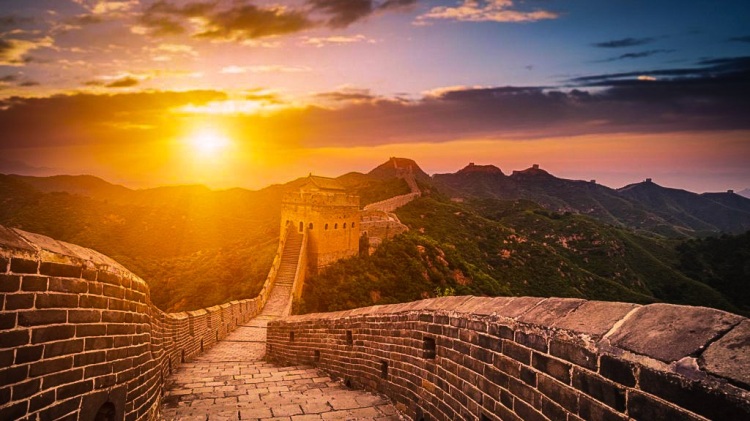
“The Great Wall’s importance to the protection and evolution of the Silk Road helped to maintain Chinese presence throughout the region. It also helped to serve the transmigration of ideas, religion and art. Buddhism came to China from Gandhara along the Silk Road.” -http://www.great-wallofchina.com/the-silk-road.html
The world is changing, but the west is clinging on to a unipolar vision of the world that has passed. It’s attempts to discard this changing reality in exchange for a western worldview expressed in their politics and media are so ungrounded, it’s comical as it is dangerous. This western bubble of reality laid down before the wests general public seems to hold up for now, although fragile and less and less by the day. Really, Russia again? Outside this western bubble however, credibility is lost daily as the west places itself on the sidelines of history.
The fundamental building blocs in western hard power and soft power are not under attack as the mediapolitical landscape could make us feel they are, it is more that they are revealed for what they are without the sugarcoating. As the multipolar world creates the political and economic power to pursuit alternatives and show new perspectives and interpretations, they now have the power to reflect the actions of the west mirrored back upon themselves as apposed to ‘just the way things are’ in the world.
Suddenly we are presented with an other version of reality that also begs for a different version of history for the past decades. Our economic system seems to benefit the few as those few have a well managed grip on politics. Local business and craftsmanship, the real economy, have given way to the privileged multinationals and the financial world, the world of tax breaks and tax havens.
Whilst the real economy is breaking down, the central banks were printing money like never before to keep the banks and the familiar names afloat -so long as the Apple’s and Facebook’s and other household na mes keep the indices up, all is good. At the root of this infinite printing of money lies of course the petrodollar. The 1973 deal with Saudi-Arabia where the US would support the house of Saud so long as OPEC would sell all oil in US dollars only and buy US bonds, creating an immense need for dollars in the world and preventing inflation as the Federal Reserves printing presses make way for the economic, political and military US might since. Since, the whole international trade system has been dollar based. If Bolivia wants to sell logs to Venezuela, it will still use dollars. And by US law, every dollar has to be cleared by the bank of New York, thus making this transaction subject to US law. And don’t you dare circumvent it. Blocking Iran from the dollar-trade for not selling oil in dollars, and thus blocking it from the swift-system, and thus from world trade, was therefore the nuclear bomb in economics. Their currency devalued 50%. The earlier threats to the petrodollar –Libia selling oil for gold, Iraq for euro’s- have been met with heavy resistance. Now, in Syr ia, it seems the world has changed. The predominantly Saudi-US creation of ISIS to destabilize the nations of Iraq and Syria into chaos has now failed. Could we again see Syria, Iraq and Iran work together to create the Friendship Pipeline (a.k.a. the Islamic Pipeline in the west), exporting oil from Iran to Europe? Or will it be more of the same political-economic-monetary-military export of the west, with freedom, democracy and human rights as it’s sugarcoating?
The guardians of a new geopolitics: Iran-Russia-China

The demise of military hegemony
The success-story of the liberation of Syria by ISIS is a result of the Astana peace talks between Russia, Syria, Turkey and Iran, not the Geneva talks where the US made promises it broke within days on the ground. It is the cooperation of Hezbollah, Iran, Iraq and Russia (as tides changed, Turkey) that in spite of US-Saudi aid to ISIS managed to liberate the countries of Syria and Iraq. The military power of Russia, with for example it’s S-400 anti-missile all over the middle east is a game-changer. It’s a defensive system that leaves air-intervention in a padlock. Turkey as well as Saudi Arabia buying these demonstrates once more the break down of this unipolar world. Where NATO’s version is unable to attack ‘friendly’ aircraft -friendly as defined by NATO-, the S-400 is neutral in this aspect and respects the autonomy of a country.
The success-story of the liberation of Syria by ISIS is a result of the Astana peace talks between Russia, Syria, Turkey and Iran, not the Geneva talks where the US made promises it broke within days on the ground. It is the cooperation of Hezbollah, Iran, Iraq and Russia (as tides changed, Turkey) that in spite of US-Saudi aid to ISIS managed to liberate the countries of Syria and Iraq. The military power of Russia, with for example it’s S-400 anti-missile all over the middle east is a game-changer. It’s a defensive system that leaves air-intervention in a padlock. Turkey as well as Saudi Arabia buying these demonstrates once more the break down of this unipolar world. Where NATO
As for within Syria, where Iran and Russia are invited by Syri a and are legal in respect of international law, the United States is seen as an invader by Syria. Also, but most importantly, Assad is popular in Syria itself and self-determination is being undermined. It must sound as alienating to a west man’s ears as Assad stressing education and health services in the rebuilding of Syria or the gas attack being from ‘moderate rebels’, not Assad’s government. At the moment 95% of Syria has been freed from ISIS (sometimes known as moderate rebels in the west), yet the Uni ted States is still making a last-minute effort to control the border of Iraq and Syria to prevent regional integrat ion -or a pipeline. They will fail.
The demise of economic hegemony
For the past decad es the west has been producing less and less, as cheap labour was found in the east. It seemed to make the average western person rich as purchasing power (pp) rose. These riches are however the fruits of the rise of technology, oil and the currency devaluation of e.g. China. This cheap produce from the east could be branded to sell for many times it’s cost as this gave way to multinationa ls and the service and retail industry in the west. Likewise, cheap money from the printing presses allowed for financial industry to bloss om. And on the other side of the petrodollarcoin, the OPEC-countries maintained whatever powers that were via the high oil prices the world paid them and US protection.
For th
As the west and OPEC-countries profited of cheap labour, China saw a boom in exports that developed their country. China then used these profits to buy US obligations to keep their currency low as it blew up the dollars value even more. You could say a whole generation of Chinese has had to sacrifice/wor k their way out of a dollar-dominated trade.
Besides the rise of purchasing power (PP) in the east soon meeting the demise of PP in the west and besides the oil price having plummeted with fewer petrodollars to recycle into the US economy, there is also the factor of technology that undermines the unipolar world, the western favoured world.
Multinationals of the west used to be able to buy up cheap products, market them and sell them off highly priced, supporting whole industries in advertising and the service and retail sector. The internet however has now made it possible to bypass these western cooperations and to buy directly from small and medium enterprises (SME’s) in China.
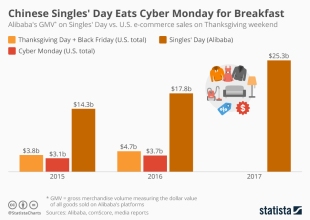
Alibaba processed 812 million orders within 24 hours and its payment service Alipay handled 1.5 billion transactions during the day, peaking at an incredible 256,000 transactions per second.
Chinese export subsidies make it very affordable to ship these products all over the world, where for example a European import tax on goods over €30 from China seeks to limit this. As Alibaba allows western SME’s to buy directly from Chinese SME’s, bypassing import and export companies and western branding, so does AliExpress make these products available for the consumer. As this will temporarily save western purchasing power, it will in the lo ng run also favour the real economy over the one pushed upon us by the wests hegemonic structuring of political- economic power. Less and less money will flow through this hierarchical organizing of society. And, “By 2020, China will account for about 60% of global e-commerce.F” – orbes
China seeks to be at the forefront of the third industrial revolution by heavily investing in automation and renewable energy. “Somewhere around 80GW of solar manufacturing capacity exists in China, of 130GW global – using 50 of those 80 gigawatts is clear evidence that China is no longer focusing on exports.” –Electrec. China knows it will have to invest in automation and renewables, as the rise of wages is already putting pressure on economic growth. The Chinese are pricing themselves out of the market. This concept of economic interconnectivity of the real economy by connecting SME’s and customers is part of China’s ‘win-win‘-strategy of diplomacy abroad. This is where the Belt and Road Initiative (BRI), fits in too. Both seek to facilitate and steer, rather than dominate. Like a parent would a child, a very Chinese view of government. The BRI is the largest infrastructural realization the world has seen to day and seeks to connect China via large infrastructure projects, or so called ‘new silk roads‘, with the rest of the Eurasian continent, guarenteeing export for the foreseeable future as the Chinese economy is changing away from a production-oriented economy.
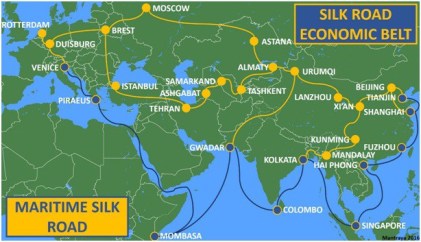
Belt and Road Initiative (BRI)
BRI connects the economies by annihilating time and space and creates interdependence, ideally preventing regional instabilities or wars. The ‘win-win’ presents a clear business alternative against the hegemonic ways the west organizes the world to the advantage of those that have the advantage already.
One of these new silk roads will connect China via high speed rail and road to Europe via Russia, drastically reducing traveling time of goods and people. China and Russia have also found each other in bypassing the US dollar in bilateral trade. “In 2016, the share of national currencies in payments for exports of Russian goods and services was 13 percent, imports 16 percent. In the first quarter of 2017, these figures rose to 16 percent and 18 percent, respectively,” said Russian Deputy Prime Minister Sergey Prikhodko. Jack Ma’s Alibabi/Aliexpress has also been invited to stimulate, dive rsify and localize Russia’s economy by creating a Russian arm of the company. Russia already diversified the economy over the past years dropping oil and gas state revenues from over 50% in 2014 to 39% now and less than 1/3rd expected in 2020. When sanctions from the west came for (people in) the oil, banking and military industry, Russia chose to reply with sanctions that affected the real economy, promoting the growth and diversifacation of local industry, creati ng an immense growth and maturation of their agricultural sector. The russian economy is remarkably self-relient in agri culture. “Russia is one of the world’s leaders in exports of grai n, vegetable oils, fish, and a number of other foods. We expect to become the leading supplier of ecologically clean food to our neighbors in the Asia-Pacific region.” , published by Russia ahead of the APEC meeting of last november.
It would be intere sting for people in the west to listen to a Valdai speech of Vladimir Putin, the speech of Xi Jinping at the 18th Central Committee of the Communist Party of China or to the balanced words of Hasán Rouhaní when confronted with polarizing western rhetori c. For most in the west however , the m ind has constructed views of these countries that are hard to break, based on allegations circulating within the western bubble of reality that see k to polari ze and justify the unipolar hegemony. Russia’s RT has successfully been able to show different understandings of the world and has become the object of discussion itself. It’s usually a disturbing allegation brought forward by a politician, backed up by institutions and amplified by media. It either consequently lacks any proof of the allegation and usually ends in self-reference to the wests mediapolitical show and might even be corrected when the attention of the media has shifted to a new hype or is either so blown out of proportion that it fails to make the argument. This includes the election-hacking I’ve written(Dutch) about before, as well as the whole Crimea-unification, as I’ve written about before as well. There is a world of views to discover for which I hope we may find ourselves mature enough to decide over ourselves. Geopolitical analyst Pepe Escobar put it wonderfully when visiting Iran, “So once again, in Tehran, provoked by the meeting of minds around the conference – the absolute opposite of “clash of civilizations” – it was possible to discuss how Iran (resistance against injustice), China (remixed Confucianism) and Russia (Eurasianism) are offering post-Enlightenment alternatives that transcend Western liberal democracy – a concept that has been completely co-opted and shattered by the hegemony of neoliberalism.”
The longer the mediapolitical west keeps up the false narratives around Russia, Iran and China for maintaining their unipolar worldview, the more it will distance itself from the socioeconomic integration in the world around them. It will happen slowly -China favours stability-, as our growth slows down and tourists will visit our historic scenery. The new Silk Road doesn’t have to stop in Istanbul or Moscow, it can connect through to the harbour of Rotterdam and go via Berlin. The concept of the enemy is the produce of a society that lacks the leap of trust to participate in a lateral way in the challenges of tomorrow.
The west will have to start to understand that the ideas of the enlightenment, the concepts of freedom, democracy and human rights are sh attered not by the development of the rest of the world -the exception of ISIS noted-, but by the stratification of a society undermined by monetary and neoliberal concepts that have hollowed out their ideals. As for spreading those ideals of human rights, freedom and democracy abroad, we might do well listening once again to the east. The Chinese do not argue these principles, yet are in no way co nvinced of the path dictated by the west, nor the moral high ground to preach from. They see these principles arising out of economic development. Out of a rising middle-class and basic needs for citizens -thus free of poverty and free from harsh economic inequality- will arise democracy. These values have to be developed and can not be enforced without economic democracy and basic needs. How can you expect someones human rights to come first, does not your survival do? In the export of Chinese ‘win-win’ diplomacy, it does not seek to impose a way of living, a certain developmental path. It provides stability, a way for both economies to become interdependent, of which cultural exchange and respect may follow.
The west is in debt, immensely. And this time it’s not only consumer debt that resulted in the mortgage crises of 2008, it’s also corporate debt, states, bond markets, you name it. Whatever credit market the crises will start in, it will spill over resulting in a crash far greater than 2008. The real wealth has moved east. Sure, China has debt, but it also has growth and ac tual production and it’s debt is small in comparison. Russia and Iran hardly have any debt. Gold is moving from west to e ast and is in high demand. We can’t see it reflected in the price yet, for the wests money printing presses and their leveraged ‘paper gold’ still manage to hold down the prices, but the direction is clear.
If not for production, resources or gold, what still backs a euro or a dollar? With bitcoin gaining credibility with each passing day, be it for storage or as currency, the euro/dollar demise doesn’t even stop there. Blockchain, the technology behind bitcoin, allows for the whole replacement of most of the financial world that forms one of the last strongholds of western power. Ethereum’s ether does not only allow for new coins (the famous initial coin offerings where lots of money is bound to be lost) on top of their base system, but this also allows for smart contracts. These have the potential to replace any mortgage, loan or other smart contract you could think to need a financial institution for. In time, settings in a pr ogram or on a site will make th ese interpersonally, with the community to verify for the conditions made. Russia, the first state to anno unce so, has it’s CryptoRuble ready, undoubtedly balancing the perseverance of the state (taxes) with the newfound freedoms and stab ility of digital money.
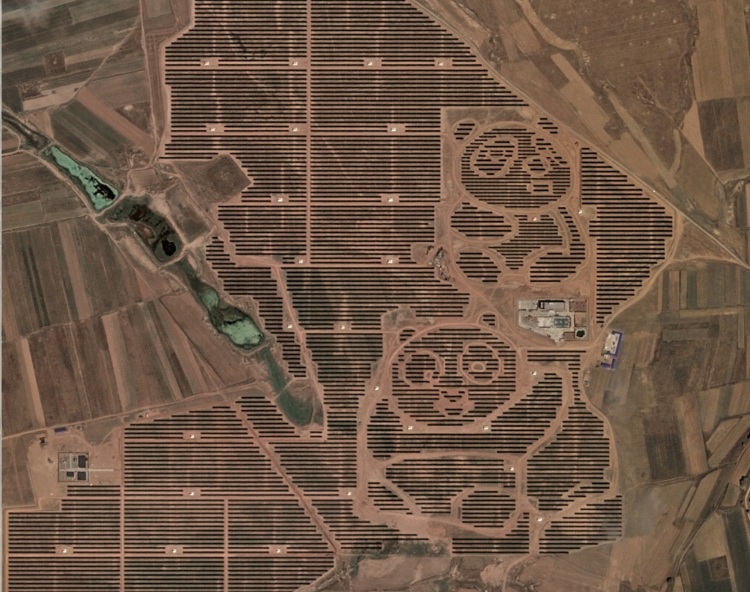
China’s Panda Power Plant
With the west to be behind in automation and renewables, without production and resources and no multinationals and financial world to profit of others, what are we but left in dependency? It’s time to find ground in roots of the renaissance and the enlightenment, find strength in local economies connecting laterally to local economies, find autonomy in renewables and find security in cryptocurrencies and gold as we connect ourselves to a future we can pull forward ourselves, away of dependance of institutions and corporations we can not rely on and in spite of their hinderance. As we pull out of globalization as put forward by the west, we will see the world connect globally from a local angle. And, as automation and technology can decentralize, they can provide locally. Think crypto instead of central bank or mortgage, solar instead of OPEC, 3d-printing directly from local resources instead of shipping from afar, the arts and craftsmanship (a design at the local 3D-shop?) instead of the wage-slave, vertical farming instead of p overty and local abundance instead of global scarcity. It’s a way of thinking that puts autonomy and free time back up front. Wasn’t that wh at freedom once meant? And from that place, we will see each other in shared pursuits of dreams.
Surely, all societies have flaws and have challenges to work on, as I understand this is the case in China, Russia and Iran, however, a western attitude of false moral superiority prevents understanding. How can we adapt to a future we understand less and less? The more the west will put in the full weight of it’s apparatus based on the old industrial revolutions and monetary and mediapolitical hot air, the harder the fall will be. The more the west clings on to this western bubble of reality brought to them by giving ear to their mediapolitical, the more certain it’s demise will be. The multipolar world now holds up a mirror, it’s about time the west dare look into it. It’s time for the west to grow up and join a new world in the making.
Sunday, November 19, 2017
CHINA FRAUD EXPOSED! There is NO Collateral Backing the Chinese Banking ...
- CHINESE JUNK BONDS AND BANKING AMOUNTS TO OVER US$43-TRILLION AND BACKED BY A MERE US$2-TRILLION IN US BONDS WHICH IS ALSO CRUMBLING UNDER A PONZI SCHEME OF MONETARY FRAUD.
- WORLD DEBT TOTALS OVER US$217-TRILLION, THE LARGEST BUBBLE IN HISTORY AND ITS COLLAPSE IS BEING CONSTANTLY ADJOURNED BY QUANTITATIVE EASING AND BUY BACKS.
- ALL MARKETS (STOCKS, BULLION, BONDS (INTEREST) CURRENCY, COMMODITIES) ARE BEING MANIPULATED IN THE US, JAPAN, CHINA AND EU.
- INDIA IS THE LEAST CORRUPT.
S&P Global Ratings cut China’s sovereign credit rating for the first time since 1999, citing the risks from
The sovereign rating was cut by one step, to A+ from AA-, the company said in a statement late Thursday. The analysts also lowered their rating on three foreign banks that primarily operate in China, saying HSBC China, Hang Seng China and DBS Bank China Ltd. would
“China’s prolonged period of strong credit growth has increased its economic and financial risks,” S&P said. “Although this credit growth had contributed to strong real gross domestic product growth and higher asset prices, we believe it has also diminished financial stability to some extent.”
The downgrade, the second by a major ratings company this year, represents ebbing international confidence China can strike a balance between maintaining economic growth and cleaning up its financial sector. The move may also be uncomfortable for Communist Party officials, who are just weeks away from their twice-a-decade leadership reshuffle.
"It’s bad optics for China, especially when they’re out there from a policy and rhetorical standpoint talking
China’s Finance Ministry said in a statement Friday that S&P ignores the country’s sound economic fundamentals and that the government is fully capable of maintaining financial stability if it strengthens supervision and controls
The official Xinhua News Agency said in an analysis late Thursday that the downgrade won’t hurt foreign investment and doesn’t reflect the nation’s economic situation, citing experts.
Scholars at
The world’s second-biggest economy is forecast to slow after a robust first half, when it started the year with the first back-to-back quarterly acceleration in seven years, then surprised economists by matching that 6.9 percent expansion again in the second quarter. Economists surveyed by Bloomberg this month project growth will remain above 6 percent through 2019.
The International Monetary Fund last month increased its estimate for China’s average annual growth rate through 2020, while warning that it would come at the cost of rising debt that increases medium-term risks to growth. This month, IMF Managing Director Christine Lagarde said at an event in Beijing that leaders are making critical efforts to rein in risk.
"The impact for
Gradual Deleveraging
While regulators are making efforts, deleveraging earlier
History suggests little relationship
Foreign investors make up less than two percent of the onshore bond market -- something policy makers are trying to change. Debt issued offshore by Chinese borrowers has been in effect mainly domestic, with local buyers taking up about 65 percent of bond sales in the first half of the year, according to Australia & New Zealand Banking Group Ltd.
"The cuts of Moody’s and S&P don’t really reflect the international investors’ view on China’s economy," said Wang Tao, chief China economist at UBS Group AG in Hong Kong, adding that risks have been reduced, corporate profits are rising, shadow financing has been reined in and capital outflows contained, she said. "This is pretty behind the curve."
No Surprise
In the event that China were to default on its external debt, S&P said that three foreign banks operating there would be "unlikely to withstand a stressed scenario."
Moody’s cut its rating on China to A1 from Aa3 in May, citing similar concerns over economy
“The market has already speculated S&P may cut soon after Moody’s downgraded,” said Tommy Xie, an economist at OCBC Bank in Singapore. “This isn’t so surprising.”
— With assistance by Yinan Zhao, Xiaoqing Pi, Kevin Hamlin, Miao Han, Emma O'Brien, and Enda Curran
India: Economy
Growth in FY2017 (ending 31 March 2018) is expected to be lower than forecast in the Asian Development Outlook 2017 as a new tax regime poses transitory challenges to firms and as investment by state governments and private investors remain muted. A pickup is envisaged in FY2018, aided by restructured
GDP Growth: 7.1
Economic forecasts for South Asian countries
| Country | 2017f | 2018f |
|---|---|---|
| Afghanistan | 2.5 | 3.0 |
| Bangladesh | 7.2 | 6.9 |
| Bhutan | 6.9 | 8.0 |
| India | 7.0 | 7.4 |
| Maldives | 4.2 | 4.4 |
| Nepal | 6.9 | 4.7 |
| Pakistan | 5.3 | 5.5 |
| Sri Lanka | 4.5 | 5.0 |
| Average | 6.7 | 7.0 |
+++++++++++++++++++++++++++++++++++++++++++++++++++++++++++++++
IMF Stress Tests Find $280 Billion Black Hole In Chinese Banks' Capital

The IMF released a new analysis on the instability stability of the Chinese financial system. Speaking to the media in an online briefing, some of the insights from Ratna Sahay, deputy director of the IMF’s Monetary and Capital Markets Department, hardly advanced our knowledge much.
That’s why the authorities are finally racing to contain the worst excesses of China’s insane credit boom following October’s Party Congress, for example overhauling the $15 trillion shadow banking and asset management sector. As we noted on the latter, the new measures don’t take effect until the end of June 2019, no doubt reflecting the enormity of the problems uncovered by Chinese regulators.
Sahay pointed to three main risks: credit growth, the complex and opaque financial system and implicit guarantees which “encourage excessive risk-taking” (think WMPs).
However, the IMF does a better job in explaining why a massive financial crisis in China is all but inevitable – the conflicting needs of social stability versus financial stability. According to Reuters.
But the near-termprioritisation of social stability seems to depend on credit growth to sustainfinancing to firms even when they are non-viable, it said. “The apparent primary goals of preventing large falls in local jobs and reaching regional growth targets have conflicted with other policy objectives such as financial stability,” the report said. “Regulators should reinforce the primacy of financial stability over development objectives,” the fund said.
Too late.
Xi Jinping and his predecessors allowed the excesses to go too far before Xi had solidified his grip on power sufficiently to intervene. The IMF itself has been missing in action when it comes to assessing China’s financial stability, as the latest report was the first of its kind since 2011. In terms of a financial system which has been out-of-control, we can use growth in the wealth management products (WMPs) as a proxy.

The IMF conducted stress-tests on 33 Chinese banks in a so-called “severely adverse scenario” and the majority failed. The capital shortfall even under this scenario was a staggering $280 billion dollars, about 2.5% of GDP. We should highlight – and we suspect it’s significance won’t be lost on readers – that the IMF stated in a footnote that the PBoC did not provide access to all of the “supervision data” it needed to properly conduct the stress tests. Bloomberg discusses the results.
China’s banks should increase their capital buffers to protect against any sudden economic downturn following a credit boom, the International Monetary Fund said. In its first comprehensive assessment of China’s financial system since 2011, the IMF recommended “a gradual and targeted increase in bank capital.” In a worst-case scenario, IMF stress tests suggested the country’s lenders would face a capital shortfall equivalent to 2.5 percent of China’s gross domestic product -- about $280 billion in 2016 -- together with ballooning soured loans.
Overall, 27 of 33 banks stress-tested by the fund, covering about three quarters of China’s banking-system assets, were under-capitalized by at least one measure. A larger financialcushion would better reflect potentially underestimated risks stemming from the banks’ exposure to opaque investments, and absorb losses as implicit government guarantees are removed, the fund said.
We are struggling to believe the IMF’s finding that the “Big Four” state-owned banks have sufficient capital. As we explained in detail in “How Ghost Collateral And Yin-Yang Property Loans Will Collapse China’s Credit Bubble”, there is an epidemic of fraudulent loans in China, with all parties, including the legal profession and the courts, complicit. At the same time, Xi is cracking down on the systemic corruption within government, so it doesn’t take much to link the two in the case of the Big Four. Nevertheless, Bloomberg notes the IMF’s assertions.
China’s top four banks, led by the world’s largest lender by assets Industrial & Commercial Bank of China Ltd., have enough capital, the fund said. But it said the nation’s smaller lenders, including those focused on individual cities “appear vulnerable.”
“Stress test results reveal widespread under-capitalization of banks other than the Big Four banks under a severely adverse scenario,” the fund said in its report. “Increasing capital would enhance the resilience and credibility of the financial system, as well as reassure markets.” The fund didn’t name the specific banks that need more capital.
There are some moments of mild tragi-comedy in the IMF’s report, for example, when it notes that the official proportion of non-performing loans in the Chinese banking system – 1.5% at the end of June 2017 – may understate the reality. Even using the official figures, China’s “debt at risk” exceeds most other major EM economies.

Trending Articles

Stress-testing the 22 Chinese banks under the “severely adverse” scenario, the IMF calculate that the non-performing loan ration would rise from 1.5% to 9.1%, cutting tier 1 capital ratios by 4.2%. Under these circumstances, bank would have to slow the pace of lending to the Chinese economy and the fiscal impact could exceed the direct recapitalization needs of the banking system “by a wide margin”, a.k.a a major crisis.
The PBoC responded surprisingly quickly to the IMF report. Regarding the very low official figure for bad debts, it noted that it resulted from banks having written off the bad ones, although obviously doesn’t square with the incredibly low number of defaults which continues to be a feature in the banking system. Bloomberg reports the response to the stress tests as follows.
Responding to the report, the People’s Bank of China said the assessment was generallyfair but disputed the IMF’s interpretation of the stress test results. “Comments about the stress test in the report do not fully reflect the results of the tests," the central bank said in a statement on its website Thursday. "China’s financial system has shown relatively strong capability to cope with risks.”
As we’ve found to our own cost on many occasions, hubris is not a good think when it comes to financial markets.
To its credit, the IMF’s staffers did place a lot of focus on the risk from guaranteed returns and off-balance sheet exposure in China’s $4 trillion WMP sector . Without calling it a Ponzi scheme, they identify the possibility of a bank-run.
“Off-balance sheet WMPs also represent a significant risk to capital,” the report said. “They are not guaranteed, but banks almost always compensate retail investors for principal losses. In a stress scenario, the costs to the banks of supporting WMPs could be substantial and could, in case of a run, place the liquidity position of some banks under strain.”
As part of the stress-tests, the IMF discovered four banks that could suffer liquidity shortfalls within 30 days, while confirming that the liquidity position of the Big Four was “strong” (hmmm ). Besides increasing bank capital, holding more liquid assets and reforming WMPs, we were intrigued by another of the IMF’s recommendations. The IMF stated that the PBoC and other regulators needed a substantial increase in staffing. We find this hard to believe… and very worrying… but the IMF found .
… the staff count at the “PBoC and the regulatory agencies has not risen in 10 years, while the financial sector has doubled in size.
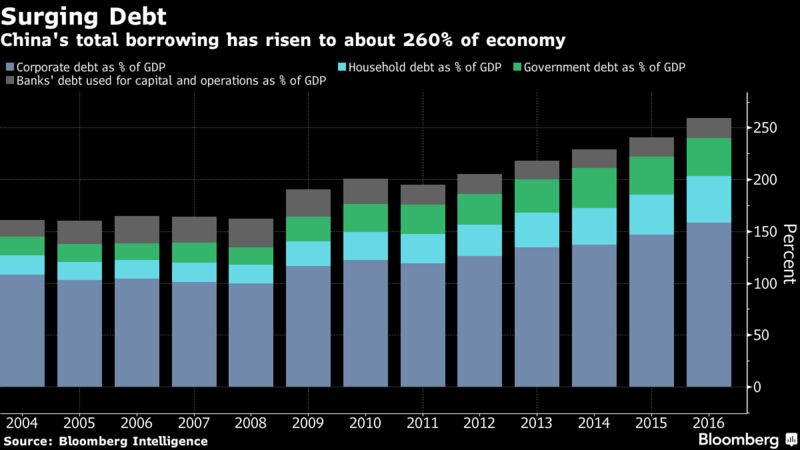
It’s even less surprising how fraudulent lending grew into an epidemic in the Chinese financial system. What the IMF report doesn’t say is that it’s gone way too far to ever be reined back in orderly fashion. We are reminded of some Bank for International Settlements (BIS) analysis discussed by Bloomberg a year ago. The BIS found that the single most reliable indicator of looming banking crises is when the aggregate of credit to households and businesses exceeds GDP by more than 10% (as it did prior to the US subprime crisis). Needless to say, China was well past the point of no return.

Subscribe to:
Posts (Atom)